

Introduction: The Cost That Rarely Triggers a Review
Idle warehouse space cost is one of the most entrenched inefficiencies in UK logistics and supply-chain operations and not because it is unknown; rather, because it has become normalised.
Across the UK, businesses continue to operate in a paradoxical environment:while warehousing demand remains structurally strong, particularly across the Midlands Golden Triangle, Greater London, and key urban fulfilment corridors yet material portions of contracted warehouse capacity remain under utilised.
This is not a problem of poor management or lack of demand. It is the result of
legacy leasing structures, conservative capacity planning, and operating models
that prioritise certainty over adaptability.
As property costs, energy pricing, and labour pressure continue to rise into 2025, the
tolerance for embedded inefficiency is narrowing. The idle warehouse space cost is
no longer a background overhead — it is a strategic variable that warrants scrutiny.
What Idle Warehouse Space Really Means in Practice
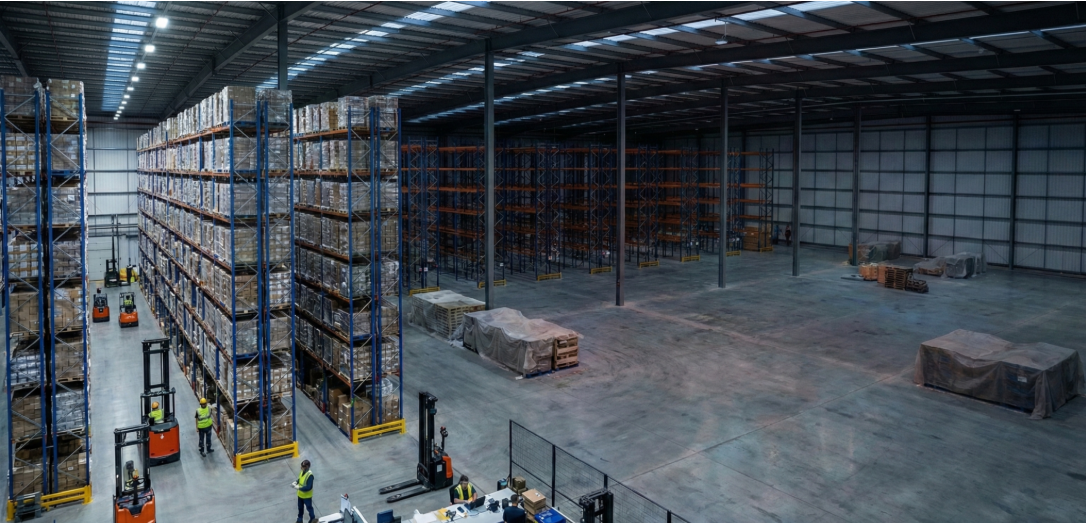
In established UK logistics networks, idle warehouse space is rarely visible as outright vacancy.Instead, it is more often embedded within otherwise operational facilities.
Masked by historic assumptions, conservative planning buffers,
Inflexible property structures.In practice, idle warehouse space manifests as structural under-performance of usable cubic capacity, not empty buildings.
This typically includes:
● Chronic under-utilisation of racked volume, where pallet locations exist but are deliberately held vacant to preserve perceived operational headroom
● Capacity ringfenced for forecast peaks driven by historic seasonality models that no longer align with post-pandemic demand volatility
● Legacy layouts optimised for outdated SKU velocity or channel mix, creating spatial inefficiency despite steady throughput
Over-leased estates, where long-term contracts outlast the commercial logic that originally justified the footprint
UK property and logistics advisory commentary including analysis consistently published by firms such as CBRE and Savills has repeatedly highlighted this disconnect:headline demand for warehousing remains robust, while effective utilisation trails
contracted capacity.
The result is not episodic inefficiency, but a structural idle warehouse space cost
embedded into day-to-day operations, often accepted as a fixed reality rather than
challenged as a performance issue.
The True Financial Impact of Idle Warehouse Space Cost
For experienced operators, the impact of idle space is rarely isolated to rent alone.
The idle warehouse space cost compounds across multiple financial dimensions
●Fixed Property, Rates & Energy Exposure
Rent, business rates, insurance, security, and energy costs apply to the total
footprint — not the productive footprint. In an environment where UK energy
volatility remains a board-level concern, unused cubic space directly inflates
operating expenditure without generating return.
● Operational Drag & Productivity Dilution
Inefficient layouts and under-utilised zones increase travel distance, reduce pick
density, and inflate labour cost per unit handled. Over time, this erodes productivity benchmark subtly not materially
● Compliance, Maintenance & Risk
Health & safety, fire compliance, inspections, and general maintenance obligations
apply regardless of utilisation. Idle areas still demand oversight, audit, and spend.
Individually, these costs appear manageable. Collectively, they form a persistent
idle warehouse space cost that quietly depresses margins and distorts cost-to-serve
models.
How Idle Warehouse Space Cost Plays Out in the UK Market
The UK warehousing environment amplifies this challenge rather than mitigating it.
● Grade A space in London and the South East continues to command premium
pricing
● The Midlands logistics corridor remains supply-constrained despite new
development
● Urban logistics sites face planning restrictions and rising rates
At the same time, many occupiers remain anchored to long-duration lease
structures designed for predictability not for today’s volatile inventory cycles and
omnichannel demand patterns.
This structural mismatch explains why idle warehouse space cost persists even
within well-capitalised, professionally managed operations.
Opportunity Cost: Capital Locked Into Under-Performance
Beyond operational expense, idle space represents a strategic misallocation of
capital.
Capital absorbed by under utilised warehousing is capital not deployed into:
● Automation and robotics
● Network optimisation and near-shoring
● ESG-driven upgrades and energy efficiency
● Service-level improvement and faster fulfilment
For retailers, manufacturers, and e-commerce operators, this constraint directly
impacts competitiveness. In tight-margin environments, idle warehouse space cost
becomes a growth inhibitor rather than a tolerable inefficiency.
Reducing Idle Warehouse Space Cost Without Destabilising Operations
Addressing idle capacity does not require dismantling existing networks. It requires
introducing flexibility into rigid systems.
● Flexible & Short Term Storage Models
Progressive organisations are decoupling storage demand from long term real
estate commitments. Flexible warehousing allows capacity to scale with actual
demand rather than forecasts, reducing long-term exposure.
● Controlled Monetisation of Surplus Capacity
For warehouse owners and operators, unused space no longer needs to remain
dormant. Short-term, controlled utilisation of spare capacity can offset fixed costs
without undermining core tenants or operations.
● Data-Led Utilisation Visibility
Mature operators are moving beyond static occupancy metrics toward actionable
utilisation insight identifying where space is productive, marginal, or structurally
idle.
Platforms such as MeterQube support this transition by enabling:
● Visibility of verified demand for under-utilised space
● Flexible, low-risk monetisation models
● Better alignment between real demand and available capacity
This reframes idle warehouse space cost from an unavoidable burden into a
manageable operational lever.
Conclusion: From Accepted Inefficiency to Strategic Control
Idle space is not simply an operational oversight it is a strategic blind spot.
For UK logistics leaders navigating rising costs, sustainability pressure, and volatile
demand.
Addressing idle warehouse space cost is now a question of capital
discipline and asset performance.
Organisations that rethink how space is leased, utilised, and monetised will operate
leaner, more resilient networks without sacrificing service levels or growth
potential.
If you operate or own warehouse space, MeterQube enables you to unlock value
from idle capacity
Access precisely the space you need, when you need it.