

From Carbon Burden to Strategic Logistics Asset
In 2025, UK Strategic logistics leaders face intensifying pressure to meet net zero commitments, tighten environmental reporting, and reduce energy costs without compromising operational
performance.
Warehousing has become a critical sustainability frontier
Buildings account for a significant share of supply chain energy consumption, and any serious
decarbonisation strategy must prioritise the smarter use of existing infrastructure over simple
expansion.
Shared warehousing, where multiple businesses operate from the same facility, directly
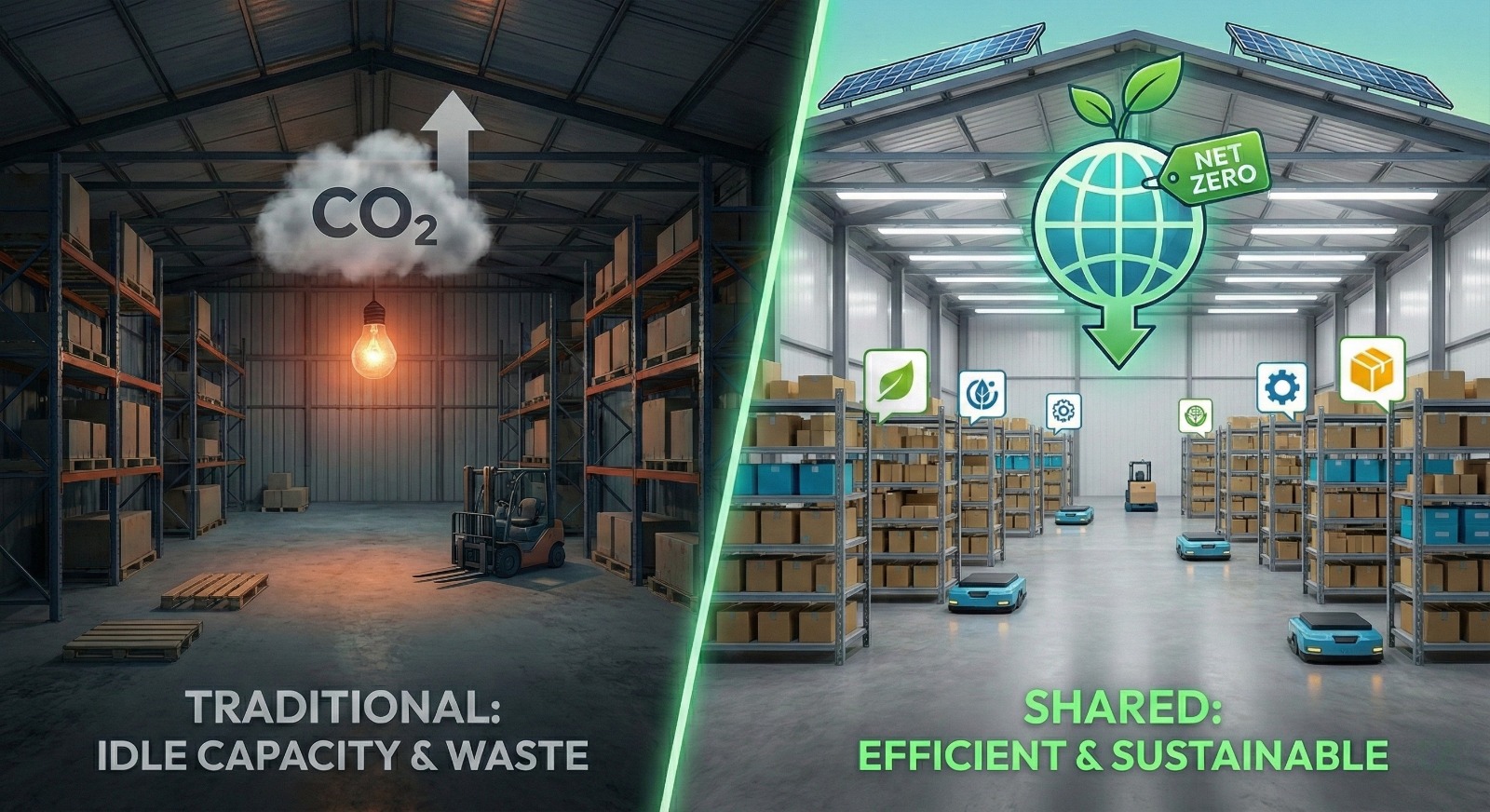
addresses two of the biggest hidden problems in logistics: idle capacity and wasted energy.
Why Traditional Warehousing Hampers Sustainability Goals
Warehouses are highly energy intensive, with lighting, heating, ventilation, and automation systems running even when the space is only partially occupied.
Studies show that warehousing representsa meaningful share of total supply chain emissions, with operational energy use often exceeding the carbon embedded in construction materials.
Two inefficiencies dominate traditional warehouse models:
1.Idle Capacity Drives Energy Waste
Large sections of warehouse space often sit unused; yet, lighting, heating, and security systems continue to consume electricity. As a result, operations burn energy without moving goods or creating value. When companies reserve space for forecasted peaks that do not materialise, the carbon footprint rises while productivity remains flat..
2.Over-Expansion Creates Structural Emissions
Many companies lease or build capacity well ahead of demand because long property cycles force conservative planning. This leads to more land use, construction, and long-term energy draw than the business actually needs,
locking in higher carbon output for years.
How Shared Warehousing Solves the Utilisation Problem
Shared warehousing focuses on one principle: using existing buildings more efficiently.
● Higher Space Utilisation: When multiple businesses share a warehouse, occupancy
levels are higher and more consistent. Heating and lighting serve active inventory rather
than empty aisles. As a result, energy consumed per pallet stored drops significantly.
● Demand-Responsive Space Allocation: Shared models allow capacity to scale up or
down as volumes change. Businesses do not need to keep excess space on standby for
seasonal peaks, preventing the long periods of under-utilisation that drive unnecessary
emissions.
● Fewer New Warehouses Required: Better utilisation of existing buildings reduces the
need for new construction. Since construction carries high embodied carbon and land
impact, using current facilities more effectively is one of the fastest ways to lower the
sector’s environmental footprint.
Measurable Environmental Benefits
Shared warehousing delivers tangible results:
● Operational carbon falls because energy systems are used more efficiently. When
occupancy is higher, emissions per unit stored decline.
● Energy efficiency investments such as LED lighting and smart HVAC systems become
more viable because costs are spread across multiple users.
● Data-driven management allows shared facilities to track space usage and energy
consumption in real time, supporting continuous optimisation rather than fixed
assumptions.
Why Sustainability Also Improves Commercial Performance
For experienced operators, sustainability is no longer separate from financial performance.
● Shared warehousing lowers fixed costs by eliminating payment for idle space. Utilities
and maintenance are shared across tenants.
● Operational flexibility improves because capacity can be adjusted without
renegotiating long leases or moving locations.
● ESG performance strengthens because reduced energy use and better asset
efficiency can be measured and reported. This matters increasingly to investors,
regulators, and enterprise customers.
How MeterQube Enables Shared Warehousing Sustainability
Shared warehousing only works at scale when capacity is visible, trusted, and easy to access.
MeterQube connects warehouse owners with spare capacity to businesses that need flexible
storage. This allows unused space to be monetised rather than wasted and lets businesses
access capacity without long-term commitments.
By matching real demand with real availability, MeterQube supports higher utilisation, lower
energy waste, and better environmental outcomes across the logistics ecosystem.
Conclusion
Sustainability in warehousing is not about adding more buildings or buying offsets. It is about
using what already exists far more intelligently.
Shared warehousing reduces idle capacity, cuts energy waste, and lowers emissions while
improving flexibility and cost control. For UK businesses navigating rising costs and tightening
environmental expectations, shared warehousing is no longer a niche concept. It is a strategic
advantage.
MeterQube makes this transition possible by turning under-used space into productive sustainable logistics capacity.